Launched in 1999 by the Ministry of Culture and Communication, the “20th Century Heritage” label identifies and highlights, through a dedicated logo, buildings and urban ensembles — protected or otherwise — whose architectural and urban significance warrants their transmission to future generations as integral elements of 20th-century heritage. Interventions on such buildings are central to dd.a’s work. The agency develops a rigorous vision of 20th-century heritage: a living legacy to be preserved, understood, and thoughtfully reactivated. It approaches this period as a field of technical, social, and aesthetic experimentation, whose transmission requires both historical accuracy and constructive intelligence. Working on modern architecture is never about freezing it in time, but about understanding its foundations — original materials, structural systems, and cultural ambitions — to rehabilitate without altering. This approach is guided by three principles: preserving authenticity, ensuring reversibility, and adapting to contemporary uses. Existing buildings become a sustainable resource: extending their life rather than replacing them, and giving meaning to 20th-century architectural gestures by re-rooting them in the present.
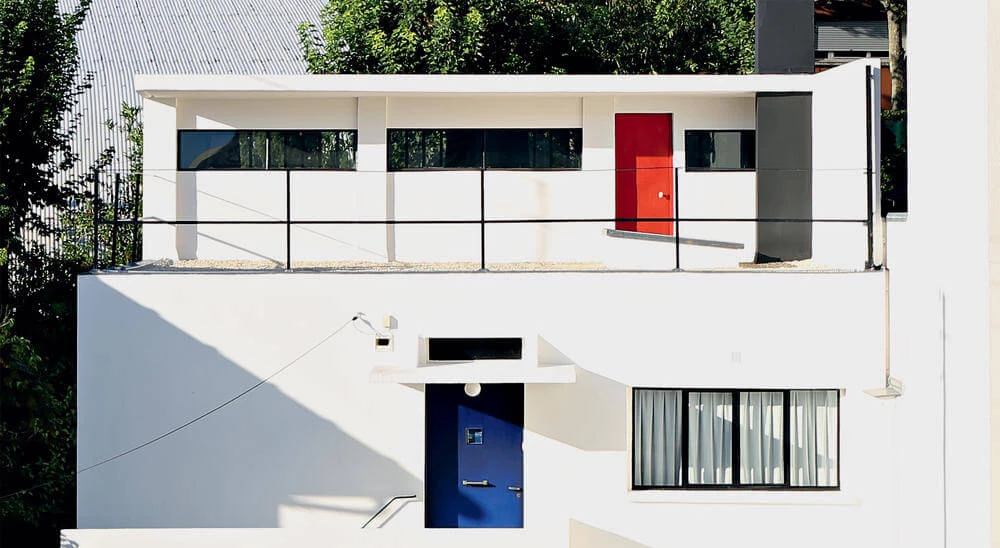
This philosophy is embodied in several emblematic projects. The restoration of Villa E-1027 by Eileen Gray and Jean Badovici, a modernist masterpiece of the late 1920s, illustrates dd.a’s ability to combine meticulous respect for materials with faithful reconstruction of the original spirit. The agency carried out comprehensive work, from architectural elements to furniture, restoring the site’s original coherence. The 2024 rehabilitation of the Téléphérique du Salève, built in 1932, demonstrates a delicate intervention on technical architecture: materials, volumes, and landscape relationships were preserved while adapting the infrastructure to current standards, earning the Prix de l’Équerre d’Argent. dd.a has also engaged with Le Corbusier’s Maisons Jaoul, studying and restoring their characteristic elements, particularly raw concrete and vaulted structures, maintaining the integrity of these modernist housing icons. Other projects confirm this approach: interventions on modernist complexes across France, restorations of postwar architecture, and rehabilitations of 20th-century technical buildings. In every case, dd.a seeks not to reinterpret modernity, but to transmit it.
Launched in 1999 by the Ministry of Culture and Communication, the “20th Century Heritage” label identifies and highlights, through a dedicated logo, buildings and urban ensembles — protected or otherwise — whose architectural and urban significance warrants their transmission to future generations as integral elements of 20th-century heritage. Interventions on such buildings are central to dd.a’s work. The agency develops a rigorous vision of 20th-century heritage: a living legacy to be preserved, understood, and thoughtfully reactivated. It approaches this period as a field of technical, social, and aesthetic experimentation, whose transmission requires both historical accuracy and constructive intelligence. Working on modern architecture is never about freezing it in time, but about understanding its foundations — original materials, structural systems, and cultural ambitions — to rehabilitate without altering. This approach is guided by three principles: preserving authenticity, ensuring reversibility, and adapting to contemporary uses. Existing buildings become a sustainable resource: extending their life rather than replacing them, and giving meaning to 20th-century architectural gestures by re-rooting them in the present.
This philosophy is embodied in several emblematic projects. The restoration of Villa E-1027 by Eileen Gray and Jean Badovici, a modernist masterpiece of the late 1920s, illustrates dd.a’s ability to combine meticulous respect for materials with faithful reconstruction of the original spirit. The agency carried out comprehensive work, from architectural elements to furniture, restoring the site’s original coherence. The 2024 rehabilitation of the Téléphérique du Salève, built in 1932, demonstrates a delicate intervention on technical architecture: materials, volumes, and landscape relationships were preserved while adapting the infrastructure to current standards, earning the Prix de l’Équerre d’Argent. dd.a has also engaged with Le Corbusier’s Maisons Jaoul, studying and restoring their characteristic elements, particularly raw concrete and vaulted structures, maintaining the integrity of these modernist housing icons. Other projects confirm this approach: interventions on modernist complexes across France, restorations of postwar architecture, and rehabilitations of 20th-century technical buildings. In every case, dd.a seeks not to reinterpret modernity, but to transmit it.