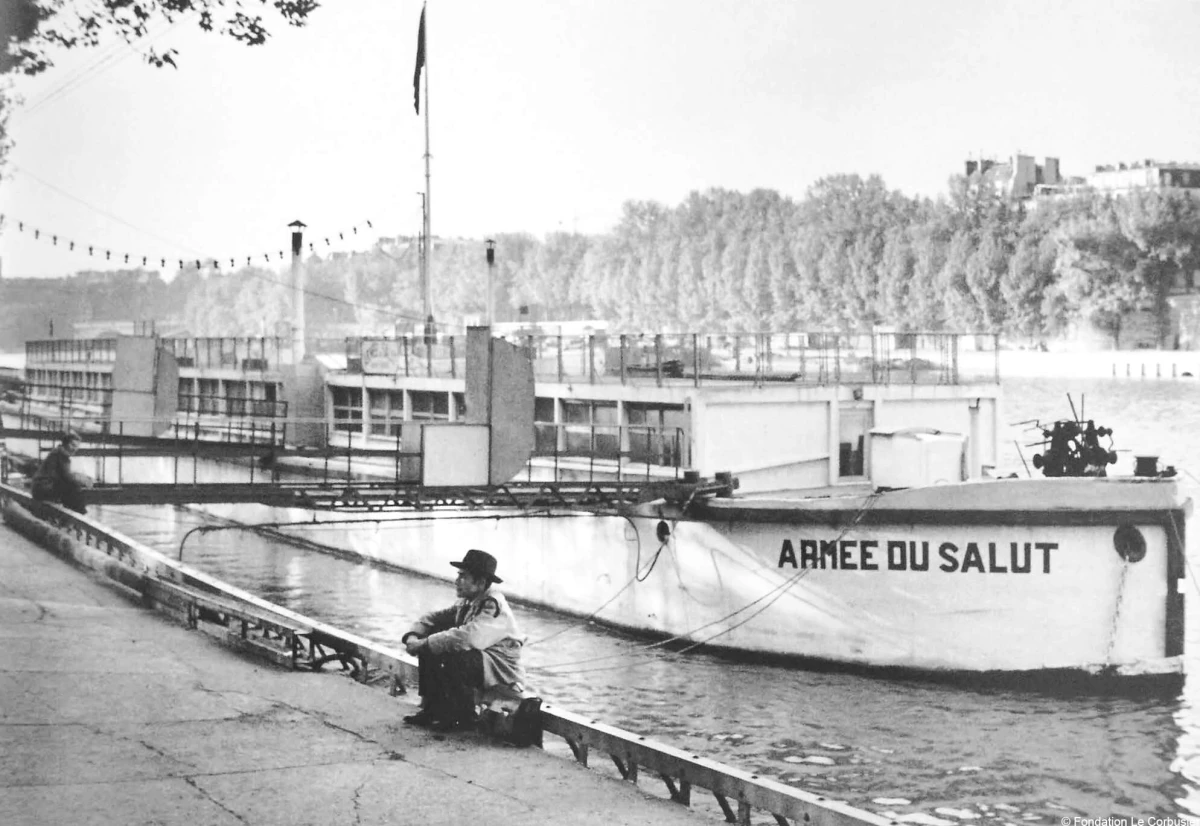
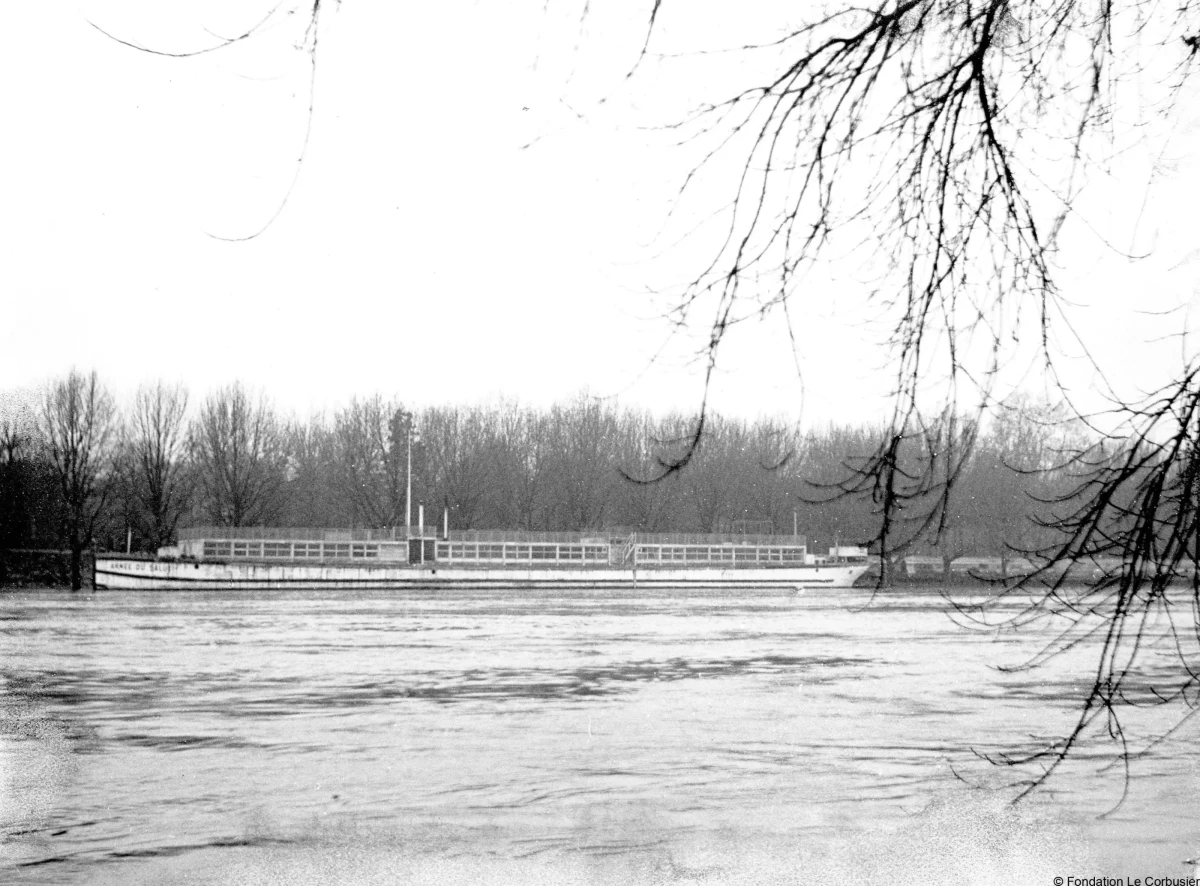
The Louise-Catherine barge, also known as the Floating Asylum, moored at 50 Quai d’Austerlitz in the 13th arrondissement of Paris, is a movable heritage object listed as a Historic Monument, in recognition of its patrimonial value and the emblematic nature of the vessel. The project was commissioned in 1929 by the Salvation Army to Le Corbusier, assisted notably by the Japanese architect Kunio Maekawa. Beyond the five codified points—pilotis, free plan, free façade, ribbon windows, and roof terrace—Le Corbusier applied a complementary principle: “to create within the created.” As he described:
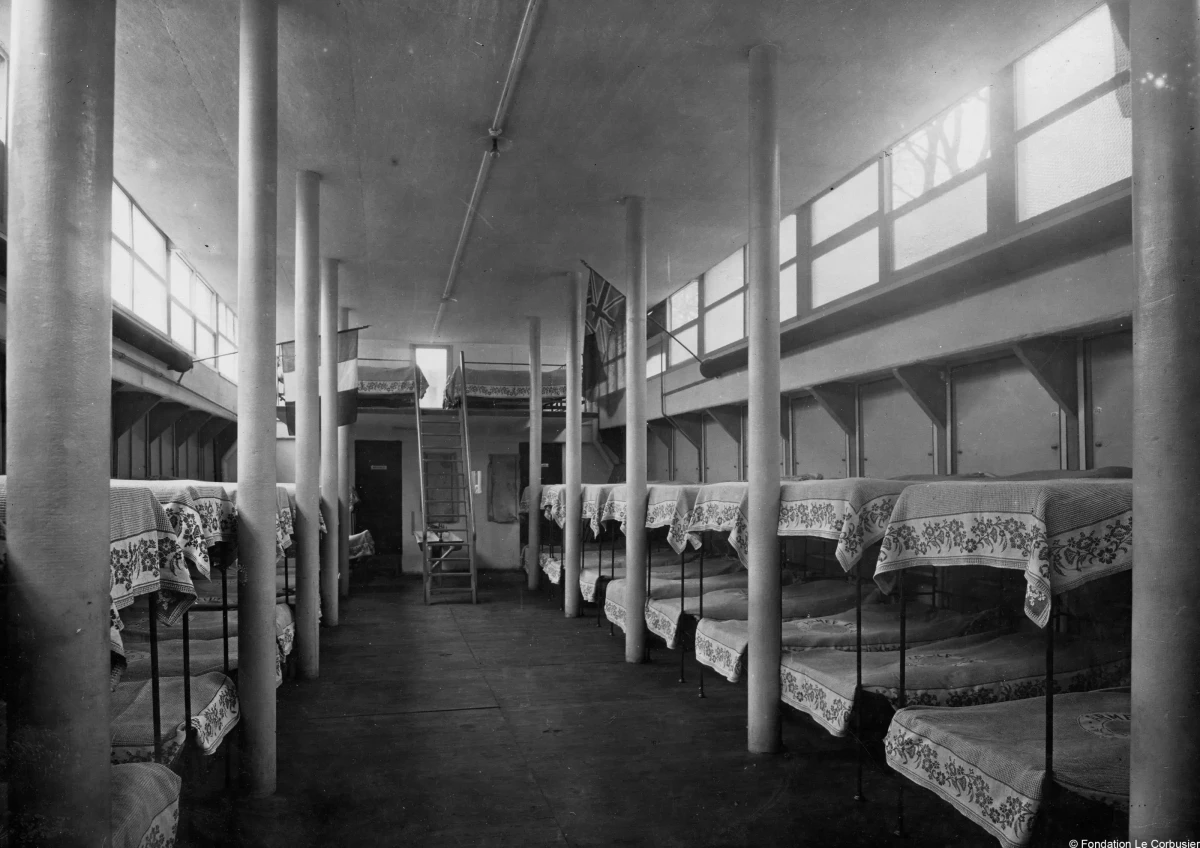
“One of the reinforced concrete barges, tested during the war, was purchased. The barge is 80 metres long. From its base to the top of the structure, a large space was built, divided into three compartments. 160 beds, a dining room, kitchens, WCs, washbasins, showers, the helmsman’s apartment, the Director’s apartment, and a hanging garden on top of the barge were arranged. In winter, the barge comes before the Palais du Louvre to shelter the homeless driven from under the bridge arches by the cold. In summer, it should serve as a holiday camp for children near Paris.”
(Le Corbusier, Oeuvre complète 1929–1934, Zurich, Les Éditions d’architecture, 1964)
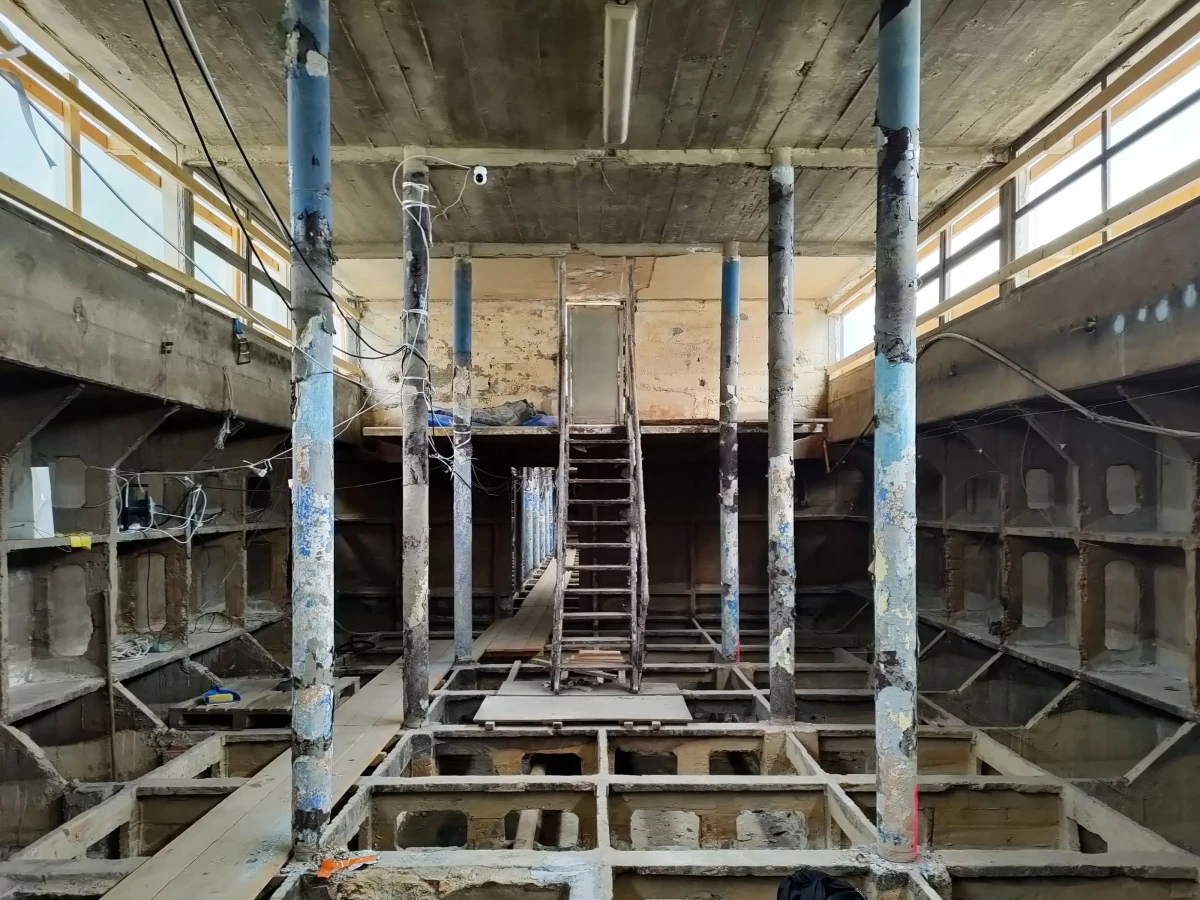
In 2018, during clearance operations from the bank, the barge sank into the Seine and remained there for three years before being refloated. It is still in a derelict state today, with eleven pumps installed to evacuate water seeping through cracks in the hull. Led by its owner, the Architectural Design Association of Nippon (ADAN), this project represents a major technical challenge, both for the conservation of an exceptional modern river heritage and for securing the structure in the context of its historical and heritage uses.
Our design team carried out a multi-criteria analysis of curative and preventive solutions for concrete conservation: passivation of corroded steel and reconstruction of concrete cover, application of corrosion inhibitors, external waterproofing, and cathodic protection. Techniques were evaluated according to four criteria: durability, reversibility, heritage impact, and cost, leading to the selection of traditional concrete repair as the most suitable solution. In parallel, investigations of the steels in the submerged hull were conducted with the specialist Secco and a team of divers from Cerema, using cofferdams designed to secure the site, in preparation for the future implementation of cathodic protection and to ensure the long-term preservation of the barge.
The Louise-Catherine barge, also known as the Floating Asylum, moored at 50 Quai d’Austerlitz in the 13th arrondissement of Paris, is a movable heritage object listed as a Historic Monument, in recognition of its patrimonial value and the emblematic nature of the vessel. The project was commissioned in 1929 by the Salvation Army to Le Corbusier, assisted notably by the Japanese architect Kunio Maekawa. Beyond the five codified points—pilotis, free plan, free façade, ribbon windows, and roof terrace—Le Corbusier applied a complementary principle: “to create within the created.” As he described:
“One of the reinforced concrete barges, tested during the war, was purchased. The barge is 80 metres long. From its base to the top of the structure, a large space was built, divided into three compartments. 160 beds, a dining room, kitchens, WCs, washbasins, showers, the helmsman’s apartment, the Director’s apartment, and a hanging garden on top of the barge were arranged. In winter, the barge comes before the Palais du Louvre to shelter the homeless driven from under the bridge arches by the cold. In summer, it should serve as a holiday camp for children near Paris.”
(Le Corbusier, Oeuvre complète 1929–1934, Zurich, Les Éditions d’architecture, 1964)
In 2018, during clearance operations from the bank, the barge sank into the Seine and remained there for three years before being refloated. It is still in a derelict state today, with eleven pumps installed to evacuate water seeping through cracks in the hull. Led by its owner, the Architectural Design Association of Nippon (ADAN), this project represents a major technical challenge, both for the conservation of an exceptional modern river heritage and for securing the structure in the context of its historical and heritage uses.
Our design team carried out a multi-criteria analysis of curative and preventive solutions for concrete conservation: passivation of corroded steel and reconstruction of concrete cover, application of corrosion inhibitors, external waterproofing, and cathodic protection. Techniques were evaluated according to four criteria: durability, reversibility, heritage impact, and cost, leading to the selection of traditional concrete repair as the most suitable solution. In parallel, investigations of the steels in the submerged hull were conducted with the specialist Secco and a team of divers from Cerema, using cofferdams designed to secure the site, in preparation for the future implementation of cathodic protection and to ensure the long-term preservation of the barge.
SECCO, steel corrosion analysis
SAMMI, structure