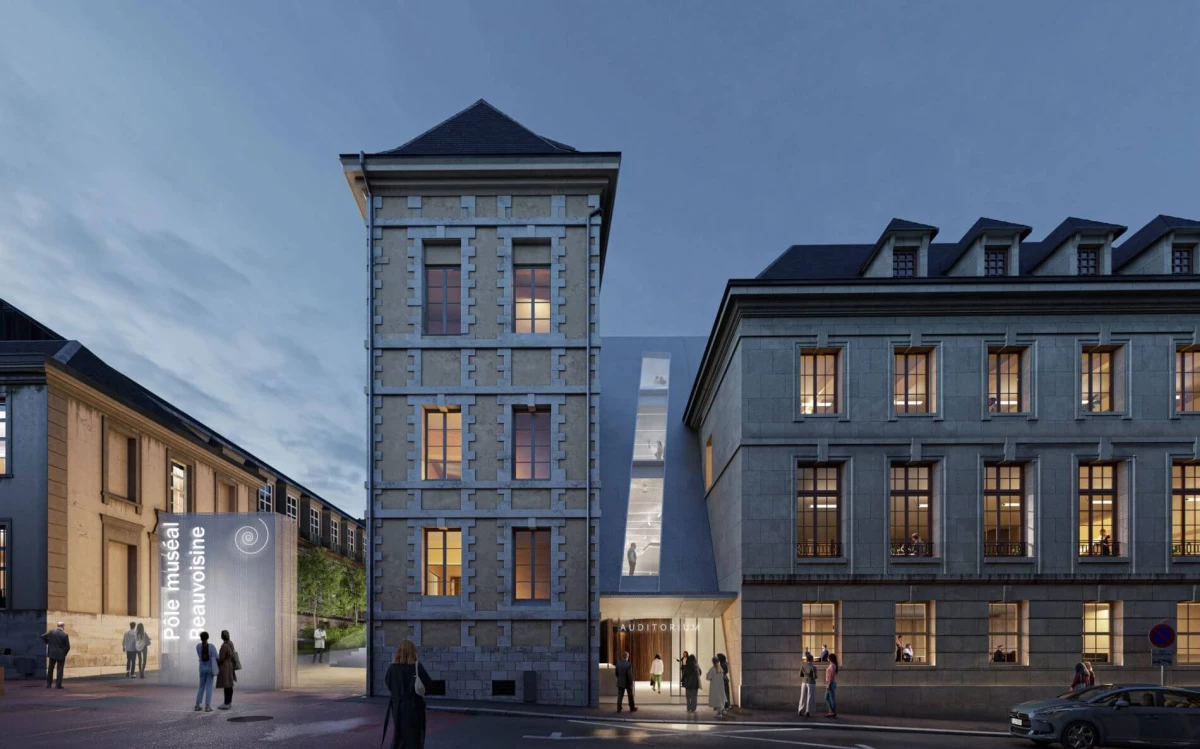
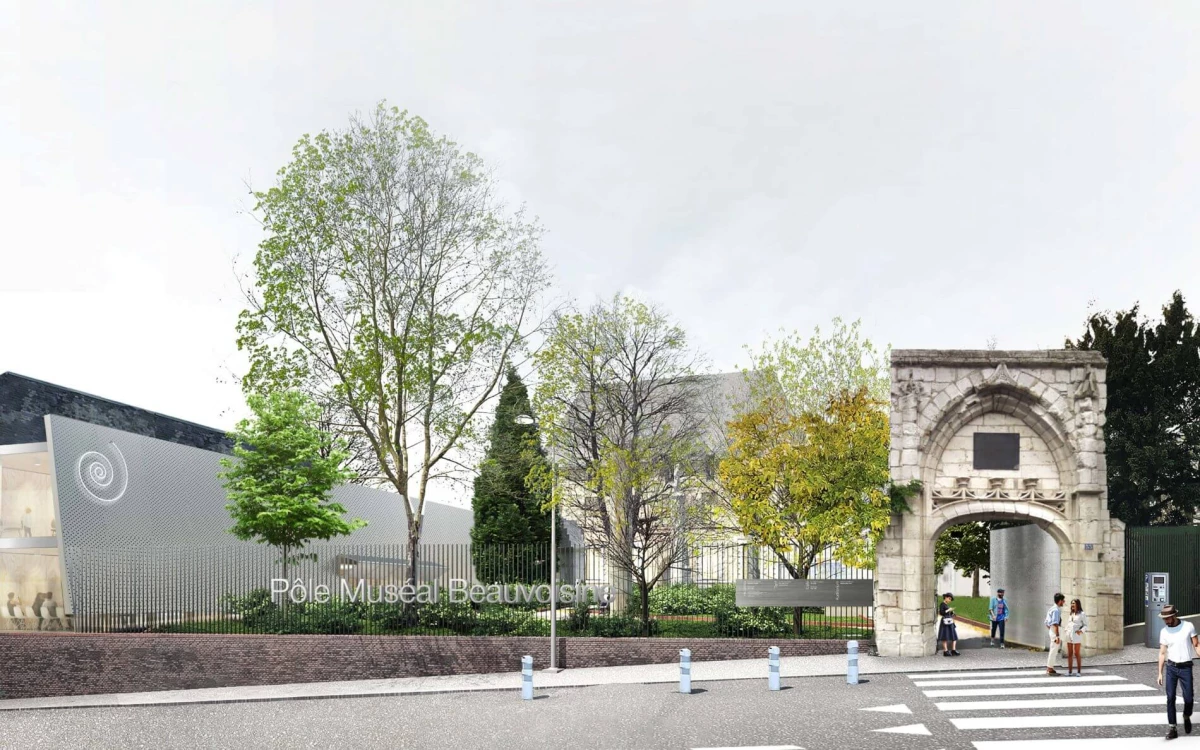
Part of the Cœur de Métropole programme, driven by Rouen’s bid to become the European Capital of Culture 2028, the project is located at the heart of the future “museum quarter.” It occupies an architectural ensemble comprising a former religious convent, whose Sainte-Marie cloister is listed as a Historic Monument, complemented by buildings from the 17th, 19th, and 20th centuries. Structured around the opening of the cloister and its landscaped garden, this ensemble forms an emblematic site in the city centre. The rehabilitation aims to bring together, under one roof, the collections of the Natural History Museum and the Museum of Antiquities, while enhancing the surrounding urban structure and the continuity of the built fabric.
The programme, developed in consultation with local residents, includes a complete redesign of the permanent route, restoration and selective demolition of existing buildings, refurbishment of the surrounding exterior spaces, and a set of contemporary museum facilities: reception, shop, and café; permanent exhibitions on the upper floors; a temporary exhibition space accessible from the entrance; auditorium; educational workshops; documentation centre; heritage interpretation centre (LIAP); and a resource centre open to the surrounding environment. The overall layout follows a continuous route: a reception area linked to the temporary exhibition and auditorium, galleries spiralling around the preserved cloister, followed by a sequence of thematic and technical spaces.
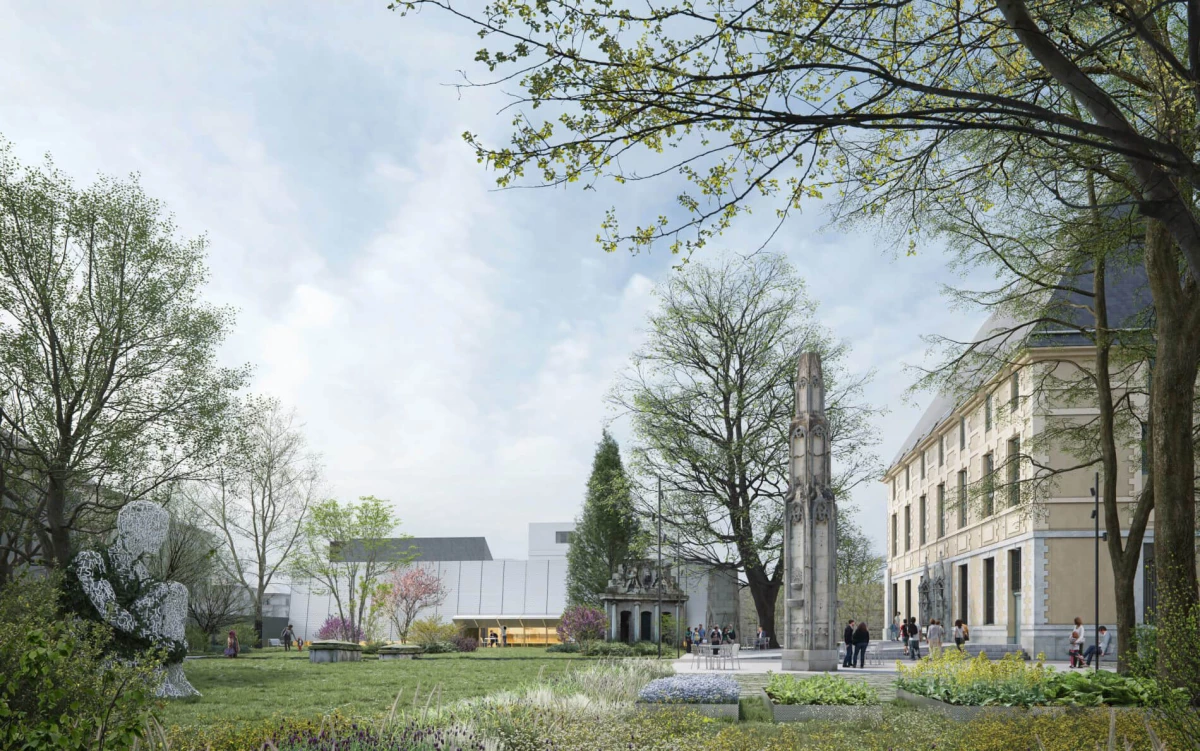
Outside, the circulation extends the visit: a central square, shaded sensory gardens, furniture and play areas, as well as vegetable and botanical gardens reinforcing its role as a neighbourhood hub. The landscape framework, based on the conservation of trees and the use of drought-resilient plantings, dialogues with the historic architecture and provides a coherent setting for activities—pause, contemplation, gathering—consistent with the spirit of the site.
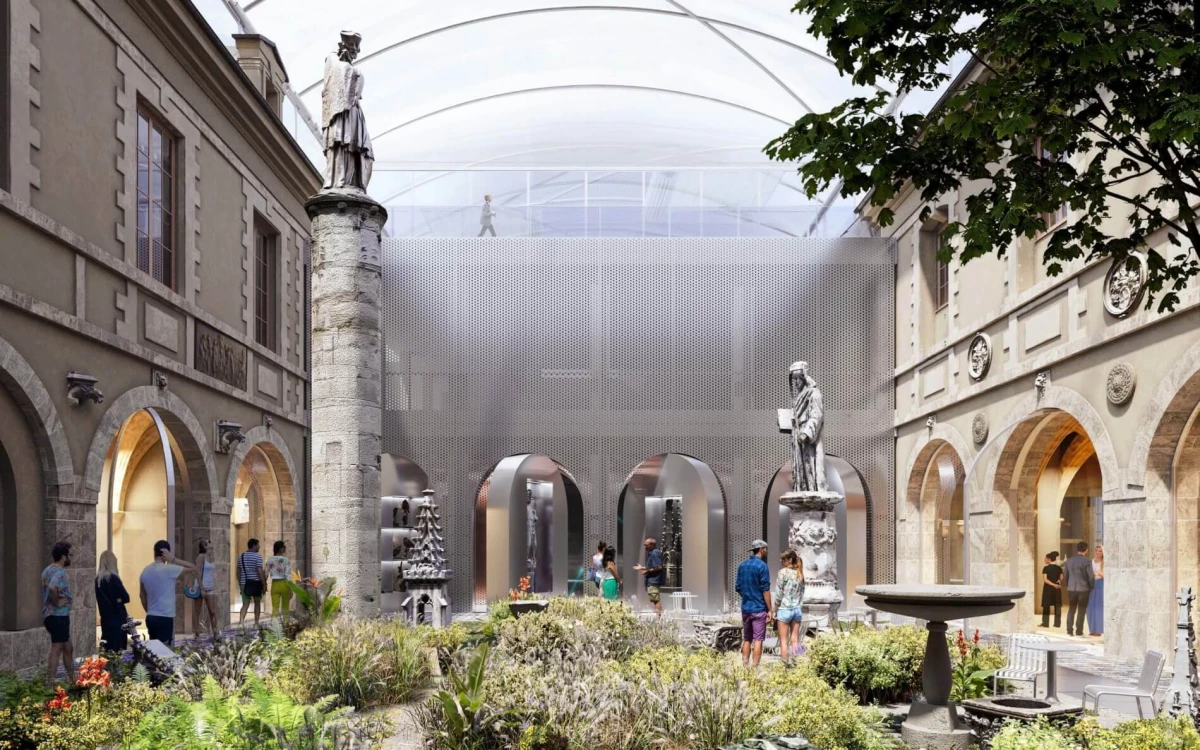
The design of the visitor route, developed in collaboration with OMA for architecture and Ducks Scéno for museography, supports all uses by providing a clear reading of distances, visitor autonomy, and multiple paths accessible from the reception. The scenographic approach follows the theme of exploration: to inspire wonder as a way of learning, using the collections to explore the natural and cultural history of the territory. Immersive installations, videomapping, contextualised décor, artistic evocations, and plays of light and sight create “contemporary theatres” where visitors construct their own narrative. This museography is integrated with existing heritage elements: historic display cases preserved in the museum galleries or former storage areas, revealed, questioned, or extended by the new installations. Together, these elements create a sensitive, educational, and adaptable route, in which the public becomes an active participant in their visit.
Part of the Cœur de Métropole programme, driven by Rouen’s bid to become the European Capital of Culture 2028, the project is located at the heart of the future “museum quarter.” It occupies an architectural ensemble comprising a former religious convent, whose Sainte-Marie cloister is listed as a Historic Monument, complemented by buildings from the 17th, 19th, and 20th centuries. Structured around the opening of the cloister and its landscaped garden, this ensemble forms an emblematic site in the city centre. The rehabilitation aims to bring together, under one roof, the collections of the Natural History Museum and the Museum of Antiquities, while enhancing the surrounding urban structure and the continuity of the built fabric.
The programme, developed in consultation with local residents, includes a complete redesign of the permanent route, restoration and selective demolition of existing buildings, refurbishment of the surrounding exterior spaces, and a set of contemporary museum facilities: reception, shop, and café; permanent exhibitions on the upper floors; a temporary exhibition space accessible from the entrance; auditorium; educational workshops; documentation centre; heritage interpretation centre (LIAP); and a resource centre open to the surrounding environment. The overall layout follows a continuous route: a reception area linked to the temporary exhibition and auditorium, galleries spiralling around the preserved cloister, followed by a sequence of thematic and technical spaces.
Outside, the circulation extends the visit: a central square, shaded sensory gardens, furniture and play areas, as well as vegetable and botanical gardens reinforcing its role as a neighbourhood hub. The landscape framework, based on the conservation of trees and the use of drought-resilient plantings, dialogues with the historic architecture and provides a coherent setting for activities—pause, contemplation, gathering—consistent with the spirit of the site.
The design of the visitor route, developed in collaboration with OMA for architecture and Ducks Scéno for museography, supports all uses by providing a clear reading of distances, visitor autonomy, and multiple paths accessible from the reception. The scenographic approach follows the theme of exploration: to inspire wonder as a way of learning, using the collections to explore the natural and cultural history of the territory. Immersive installations, videomapping, contextualised décor, artistic evocations, and plays of light and sight create “contemporary theatres” where visitors construct their own narrative. This museography is integrated with existing heritage elements: historic display cases preserved in the museum galleries or former storage areas, revealed, questioned, or extended by the new installations. Together, these elements create a sensitive, educational, and adaptable route, in which the public becomes an active participant in their visit.
dd.a, co-contracting and heritage architects
BMF, economist
EGIS, TCE
Ducks Scéno et LMPolymago, scenography
Studio DAP, acoustician
Les Éclaireurs, lighting
D’ici là, landscaper
FL&Co, preventive conservation