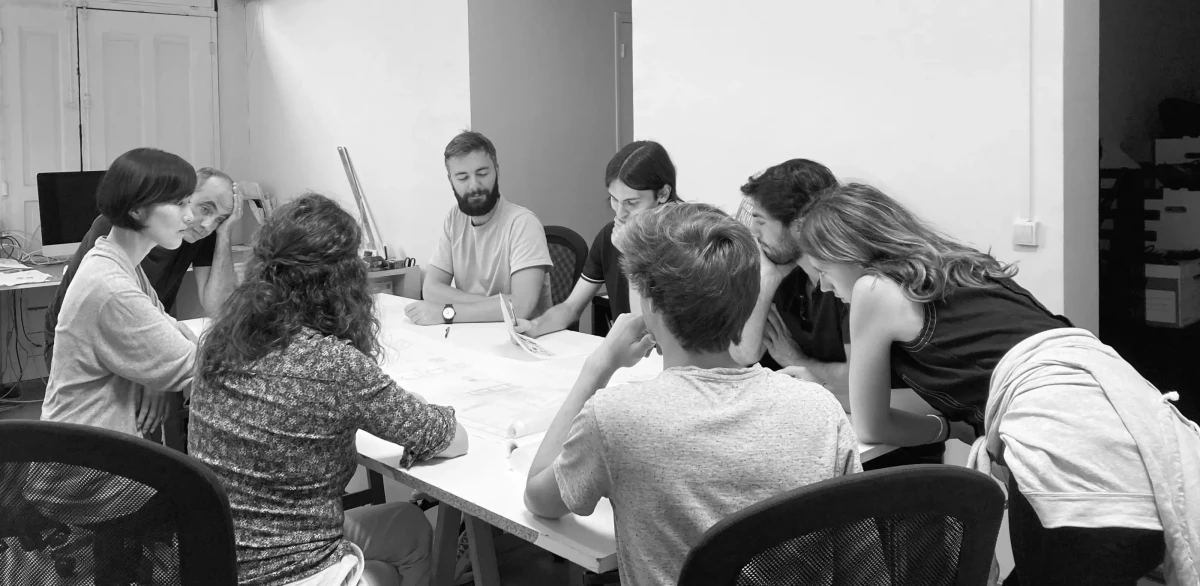
Since September 2022, twenty-five weekly workshops and two agency seminars have, over nine months, helped define the contours of dd.a’s approach for the future, informed by past and ongoing projects, external contributions, readings, presentations, exhibitions, conferences, and debates. With every project, the question of the architect’s role arises with particular urgency, especially in already-built contexts, where an existing cultural layer often imposes itself over a prior natural one. Our practice focuses primarily on restoration, rehabilitation, and creation within the existing fabric. In such contexts, buildings are almost invariably in a state of crisis: uses, forms, and materials must be reassessed.
At the same time, the Anthropocene challenges the built environment: climate change, water scarcity, and the biodiversity crisis put yesterday’s constructions to the test. Our objective is to improve the habitability and resilience of these places without contributing to their degradation, applying a simple principle: think globally, act locally. This approach involves minimising demolitions and new constructions as far as possible, while developing tools for analysing and enhancing the existing fabric. These methods, derived from our interventions on buildings of high heritage value, are not limited to material preservation but also include material reuse, accommodating living systems, maintenance, and the adaptation of uses.
The analysis of the existing environment becomes a cross-cutting process, mobilising multiple areas of expertise, extending beyond cultural heritage to include the natural and ecological dimensions of a site. Its aim is to reveal the cultural and natural history of each site of intervention, considering the existing fabric as a genuine resource for the project, and to integrate this knowledge into client decision-making. Acting earlier in the process and broadening the scale of interventions is a central pillar of dd.a’s approach, ensuring that our concerns and commitments regarding the existing fabric are taken into account from the outset of programme development.
It also involves rethinking experimental sites, whether brownfields, neighbourhoods, cities, or bio-regions. Reflection on habitability, the capacity to accommodate living systems, and the quality of public spaces must be conducted collectively. The agency’s practice is founded on a shared set of values—minimising demolition and construction, welcoming living systems, managing resources responsibly—while taking advantage of the diversity of skills and expertise to concretely improve living conditions and the quality of the spaces in which we intervene.
Since September 2022, twenty-five weekly workshops and two agency seminars have, over nine months, helped define the contours of dd.a’s approach for the future, informed by past and ongoing projects, external contributions, readings, presentations, exhibitions, conferences, and debates. With every project, the question of the architect’s role arises with particular urgency, especially in already-built contexts, where an existing cultural layer often imposes itself over a prior natural one. Our practice focuses primarily on restoration, rehabilitation, and creation within the existing fabric. In such contexts, buildings are almost invariably in a state of crisis: uses, forms, and materials must be reassessed.
At the same time, the Anthropocene challenges the built environment: climate change, water scarcity, and the biodiversity crisis put yesterday’s constructions to the test. Our objective is to improve the habitability and resilience of these places without contributing to their degradation, applying a simple principle: think globally, act locally. This approach involves minimising demolitions and new constructions as far as possible, while developing tools for analysing and enhancing the existing fabric. These methods, derived from our interventions on buildings of high heritage value, are not limited to material preservation but also include material reuse, accommodating living systems, maintenance, and the adaptation of uses.
The analysis of the existing environment becomes a cross-cutting process, mobilising multiple areas of expertise, extending beyond cultural heritage to include the natural and ecological dimensions of a site. Its aim is to reveal the cultural and natural history of each site of intervention, considering the existing fabric as a genuine resource for the project, and to integrate this knowledge into client decision-making. Acting earlier in the process and broadening the scale of interventions is a central pillar of dd.a’s approach, ensuring that our concerns and commitments regarding the existing fabric are taken into account from the outset of programme development.
It also involves rethinking experimental sites, whether brownfields, neighbourhoods, cities, or bio-regions. Reflection on habitability, the capacity to accommodate living systems, and the quality of public spaces must be conducted collectively. The agency’s practice is founded on a shared set of values—minimising demolition and construction, welcoming living systems, managing resources responsibly—while taking advantage of the diversity of skills and expertise to concretely improve living conditions and the quality of the spaces in which we intervene.